
By Nhlanhla Nene – Well-being Coach & Founder of Mindedjoy
There’s a moment many high achievers recognize—but rarely name.
You take time off.
You sleep longer.
You finally slow the pace you’ve been pushing for months.
And yet…
Something doesn’t come back online.
TL;DR: Burnout vs Exhaustion…in 20 seconds.
Exhaustion is temporary fatigue that improves with rest. Burnout is deeper — it lingers even after time off and shows up as emotional detachment, lost meaning, irritability, and fading motivation. High achievers often miss it because they’re still performing. The key difference: if sleep restores your energy but not your drive, it’s likely burnout. This isn’t weakness — it’s prolonged misalignment between effort and recovery. Burnout isn’t solved by pushing harder; it’s eased by resetting boundaries, redefining rest, and uncoupling worth from constant output.
Many high-achieving professionals struggle to recognize burnout because they continue functioning even while emotionally depleted. They remain productive, responsible, and outwardly capable—yet internally feel disconnected, exhausted, or unable to recover fully. This article explains the difference between burnout and exhaustion, why high achievers often miss early warning signs, and how chronic pressure gradually disrupts motivation, meaning, and nervous system recovery.
Burnout and exhaustion are often treated as the same thing. For high achievers, confusing them isn’t just common—it’s costly. Because exhaustion passes. Burnout reshapes how you relate to your work, your worth, and your life.
And the earlier you notice the difference, the more choice you have.
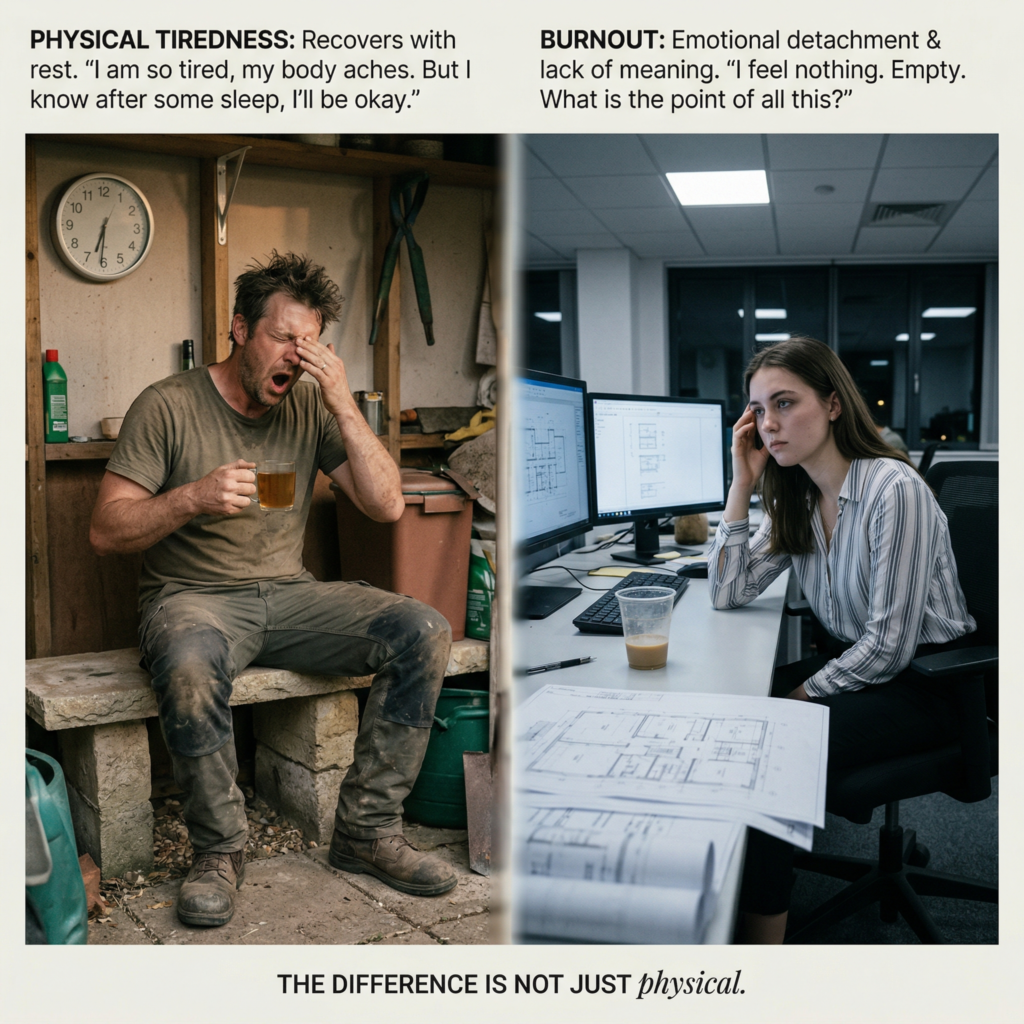
Burnout vs Exhaustion: Why the Difference Matters More Than You Think
Exhaustion is what happens when you’ve been doing a lot.
Long hours.
Sustained focus.
Short-term pressure.
It’s uncomfortable—but it’s honest. And most importantly, it responds to rest. Sleep, time off, and recovery restore you.
Burnout is different.
Burnout develops when effort outpaces recovery for too long, especially when the pressure carries emotional weight: responsibility, identity, expectations, or unrelenting self-standards.
It’s not just fatigue.
It’s depletion with disconnection.
You might still be functioning. Still producing. Still meeting expectations. But inside, something vital has thinned.
Rest alone stops working—not because you’re broken, but because the system you’re operating in (and from) hasn’t changed.
Burnout doesn’t mean you’re weak.
It means endurance has replaced nourishment.
The American Psychological Association notes that burnout and stress are at all-time highs across professions, and among already strained health care workers.
The Early Signs High Achievers Miss
Many high-performing professionals miss burnout because they remain functional externally. They continue meeting responsibilities while internally becoming increasingly detached from meaning, motivation, and emotional presence. The nervous system adapts to prolonged pressure so gradually that depletion starts feeling normal.
1. Work Loses Meaning
Not just enjoyment.
meaning
Wins feel flat.
Effort feels hollow.
This isn’t ingratitude.
It’s internal depletion
2. Energy Doesn’t Rebound
You rest.
But:
you don’t reset
Mornings feel heavy.
The fatigue feels deeper.
3. Irritability Increases
Small things:
feel bigger than they should
Not because you’ve changed—
because your reserves have
4. Focus Weakens
Tasks that were easy:
now require force
And instead of concern:
you apply more pressure
5. Quiet Avoidance Appears
You still show up.
But internally:
resistance grows
If you’re functioning externally but disconnecting internally, burnout is already forming.
“Am I Burned Out or Just Tired?”
A Simple but Honest Distinction
| Exhaustion | Burnout |
| Improves with rest | Persists despite rest |
| Mainly physical fatigue | Emotional & mental detachment |
| Motivation remains | Motivation fades |
| Temporary | Cumulative |
One of the clearest red flags isn’t tiredness—it’s how you speak to yourself.
Thoughts like:
What’s the point?
I shouldn’t be struggling like this.
Something’s wrong with me.
That voice doesn’t come from fatigue.
It comes from prolonged misalignment.
Why Burnout Feels Normal
In high-performance environments:
pressure is constant
overwork is expected
resilience = endurance
So burnout becomes:
invisible
The real question isn’t:
“Can I handle this?”
It’s:
“What is this costing me over time?”
If your environment rewards constant pressure, burnout won’t feel like a problem—it will feel like normal.
That’s why changing habits alone isn’t enough.
Structure matters
Why High Achievers Are Most Vulnerable
In my coaching work with high-performing professionals, many people initially describe themselves as simply ‘tired.’ But deeper reflection often reveals something more serious: they no longer feel emotionally connected to the work, goals, or identity they once cared deeply about.
Burnout isn’t just about workload.
It’s driven by:
identity tied to performance
self-worth tied to output
difficulty resting without guilt
constantly raising standards
This creates a loop:
perform → achieve → escalate → repeat
Without pause:
depletion accumulates
What Actually Prevents Burnout
Not doing less.
Relating differently to effort
1. Redefine Rest
Not a reward—
a requirement
2. Protect Boundaries
Availability ≠ value
3. Notice Before You Override
Awareness interrupts escalation
4. Let Wins Land
Stop immediately escalating
5. Talk Before You Isolate
Many high achievers normalize burnout because high-functioning exhaustion is often rewarded professionally. Over time, emotional depletion becomes hidden beneath competence, reliability, and continued performance.
Mayo Clinic – Job burnout overview
A Sustainable Energy Model
Think in cycles:
Effort → Recovery → Meaning → Clarity
Most people stay in:
effort
output
Very few protect:
recovery
meaning
That’s where burnout begins.
A Quiet Reframe
If rest isn’t working:
You’re not failing.
You’re:
Over-extended in the wrong system
Try:
reduce one pressure point
create one recovery space
question one expectation
Let that be enough.
You don’t need:
more effort
You need:
less constant pressure
Frequently Asked Questions
What are the earliest signs of burnout?
Loss of motivation, emotional detachment, fatigue that doesn’t resolve with rest.
How do I know if I’m burned out or tired?
If rest restores energy but not engagement, burnout is likely.
Can burnout happen outside work?
Yes—any prolonged pressure without recovery can cause it.
What should I do first?
Examine your workload, boundaries, and internal expectations.
Final Shift
Many high achievers believe the answer is building more resilience, discipline, or coping capacity.
But constant self-optimization can sometimes deepen exhaustion rather than resolve it.
What the mind and body often need is greater alignment with personal values, more intentional recovery, and less ongoing pressure.
Sustainable well-being rarely comes from pushing harder — it grows from creating conditions that support clarity, balance, and emotional restoration.
Final Reflection
For many professionals, sustainable recovery eventually requires more than stress-management techniques. It requires creating a life structure where recovery, meaning, and emotional well-being are no longer constantly sacrificed for performance. One approach I’ve personally explored is building more flexible, lower-pressure online income systems.
Affiliate disclosure: I’m an active Wealthy Affiliate memberand may earn a commission if you purchase through links on this page. I only recommend products I use and believe provide value. No extra cost to you.
Quick verdict: Wealthy Affiliate is a beginner-friendly, all-in-one platform that bundles hosting, training, and keyword tools — excellent value for new and scaling affiliate marketers.
About the Author
Nhlanhla Nene is a Wellbeing Coach, Mindvalley Certified Life Coach, and founder of Mindedjoy. With advanced training in narrative, personal, and corporate coaching — alongside a background as a Certified Global Management Accountant (ACMA, CGMA) — he helps high-performing professionals bridge the achievement–fulfillment gap and build success rooted in clarity, resilience, and meaning.