TL;DR: Why High Achievers Feel “Not Enough” After Success…in 20 seconds.
High achievers often feel “not enough” after success because their nervous systems associate performance with safety. When achievement increases visibility, the inner critic intensifies to prevent perceived risk. Building stable confidence requires separating worth from performance, practicing cognitive distancing, regulating stress responses, and cultivating self-compassion rather than self-pressure.
Written By Nhlanhla Nene – Well-being Coach & Founder Of Mindedjoy
Even after success, many high achievers experience something unexpected:
Self-doubt.
The goal is reached.
The recognition lands.
On paper, everything looks solid.
But internally?
a tightening
a subtle urgency
a familiar voice
“Don’t get comfortable.”
“You should be further by now.”
“This still isn’t enough.”
If you’ve felt this:
You are not broken.
And you are not ungrateful.
This pattern is common among high-performing professionals whose nervous systems learned early:
Achievement = safety
So when success increases visibility or expectations:
The inner critic gets louder—not quieter.
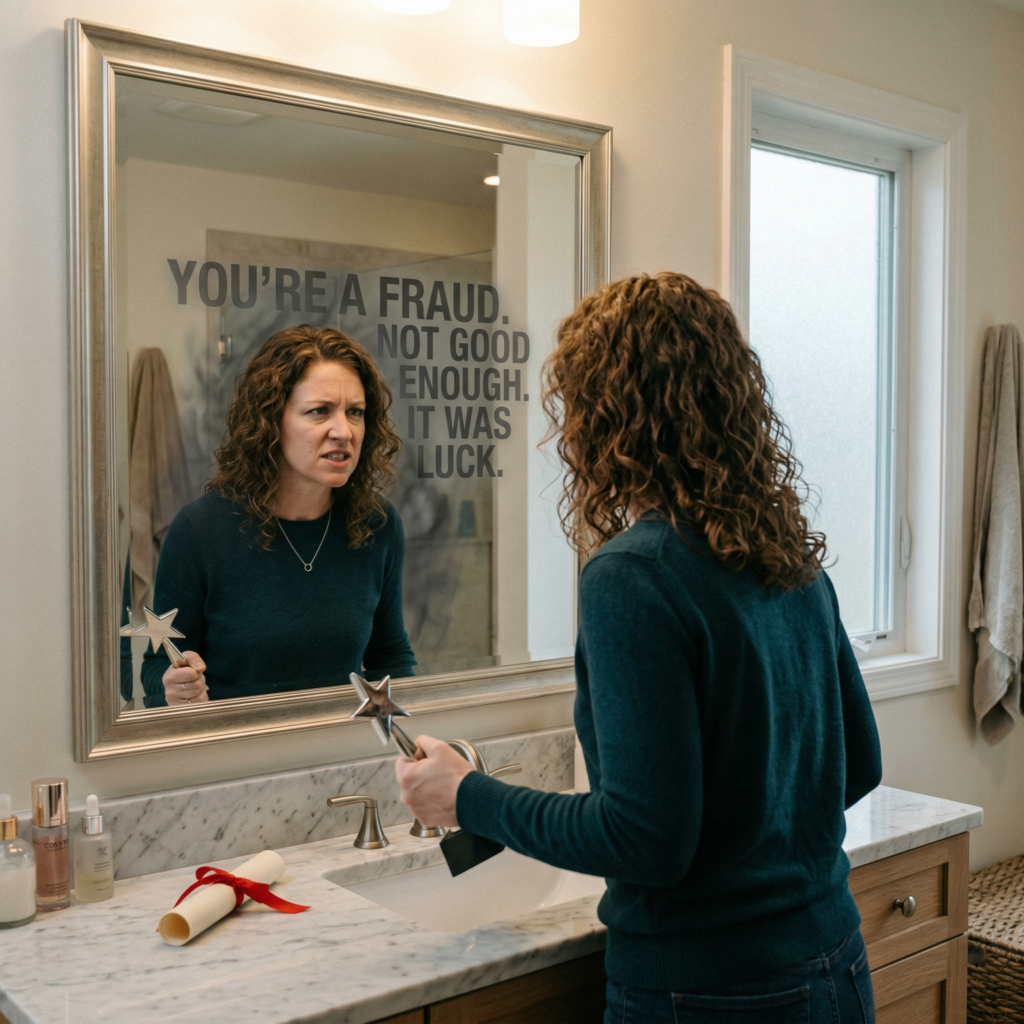
Why Success Can Trigger Self-Doubt in High Achievers
Many people assume confidence naturally increases with achievement.
Research suggests otherwise.
According to the American Psychological Association, chronic self-criticism is often linked to early conditioning around performance and approval. When worth becomes tied to achievement, success does not signal rest — it signals higher stakes.
Similarly, Harvard Health Publishing notes that self-criticism activates stress responses similar to external threat.
When worth is tied to performance:
Success doesn’t signal rest
It signals higher stakes
This is why success can feel:
tense
unstable
conditional
Instead of relief, you may feel:
on edge after wins
restless during downtime
guilty when resting
afraid to lose momentum
The issue isn’t ambition.
It’s conditional safety.
The Psychology Behind the “Not Enough” Voice
The inner critic is rarely random. It is adaptive.
Many high achievers grew up in environments where:
Approval followed performance
Expectations were consistently high
Achievement reinforced belonging
Slowing down felt risky
Over time, the brain encoded a simple rule:
Stay sharp. Stay ahead. Stay useful.
This pattern aligns with what Kristin Neff calls the “self-judgment loop” — where internal criticism is mistakenly used as motivation.
From a nervous system perspective, this also connects to stress regulation research supported by the National Institute of Mental Health, which explains how chronic vigilance becomes habitual even in the absence of threat.
The critic helped you succeed.
But it never learned:
How to stand down.
The Performance–Safety Split: A Mindedjoy Framework
To understand this pattern clearly, consider what I call:
The Performance–Safety Split
Here’s what’s happening underneath:
Achievement increases visibility
→ Visibility increases perceived risk
Risk activates vigilance
→ The inner critic intensifies
Result:
Satisfaction becomes unstable
When worth and performance fuse:
Confidence becomes fragile
This is why even highly capable professionals feel:
imposter syndrome
post-success anxiety
“not enough” despite evidence
How the Inner Critic Undermines Stable Confidence
The inner critic often sounds reasonable.
It moves goalposts subtly.
It re-frames wins as “expected.”
It keeps evaluation constant.
According to Cleveland Clinic, persistent self-criticism can increase anxiety and reduce long-term well-being.
Confidence cannot stabilize under:
constant internal monitoring
Self-trust weakens when:
everything feels like a test
How to Quiet the Inner Critic Without Losing Your Edge
This is not about eliminating ambition.
It is about separating growth from self-threat.
1. Shift From Identification to Observation
Instead of:
“I’m not enough”
Say:
“I’m noticing the ‘not enough’ thought”
This creates space.
2. Regulate Before You Reason
Grounding interrupts mental loops more effectively than arguing with yourself.
Try the 5-4-3-2-1 reset:
5 things you see
4 things you feel
3 things you hear
2 things you smell
1 thing you taste
Regulation restores safety faster than forced positivity.
3. Replace Force With Self-Compassion
Research by Kristin Neff shows that self-compassion increases resilience more sustainably than harsh self-motivation.
Instead of:
“This isn’t good enough.”
Try:
“This is allowed to be a work in progress.”
Compassion reduces threat — and paradoxically increases performance stability.
4. Separate Worth From Output
Identity-level confidence forms when:
Your value is not performance-based
Rest is not earned
Growth does not require self-punishment
Ask:
Did I act with integrity?
Did this reflect my values?
Was I present?
Confidence grows from alignment.
Not applause.
When You Need Relief, Not Insight
Sometimes it’s not cognitive.
It’s physiological.
Use:
movement
time outdoors
breathing
creative flow
The goal is not to silence the critic.
It’s to reduce its authority.
Sustainable Confidence for High Achievers
You may still hear the voice.
The difference is:
you don’t believe it automatically
you don’t organize your identity around it
you return to steadiness faster
Over time:
burnout risk decreases
fulfillment increases
Growth does not require pressure.
You start from enough—and expand from there.
Frequently Asked Questions
Why do I feel not good enough even after success?
Because your nervous system links achievement to safety.
Why does success sometimes cause anxiety?
It increases perceived risk and expectations.
Is having an inner critic normal?
Because your nervous system links achievement to safety.
How can high achievers build stable confidence?
It increases perceived risk and expectations
Can self-compassion reduce burnout?
Yes—but it becomes harmful when it dominates identity.
Final Reflection
You don’t feel “not enough” because you are lacking.
You feel it because:
Your system learned that “enough” is never safe.
Final Shift
You don’t need:
more achievement
more pressure
more proving
You need:
A way of succeeding that allows you to feel enough—without earning it every time.
Some professionals eventually realize sustainable well-being also requires redesigning how they work, earn, and structure their energy. One approach I’ve personally explored is building more flexible, lower-pressure online income systems.
Affiliate disclosure: I’m an active Wealthy Affiliate memberand may earn a commission if you purchase through links on this page. I only recommend products I use and believe provide value. No extra cost to you.
Quick verdict: Wealthy Affiliate is a beginner-friendly, all-in-one platform that bundles hosting, training, and keyword tools — excellent value for new and scaling affiliate marketers.
Author Bio
Written by Nhlanhla Nene. Nhlanhla is a Well-being Coach, Mindvalley Certified Life Coach, and founder of Mindedjoy. With advanced training in narrative, personal, and corporate coaching—combined with a background as a Certified Global Management Accountant (ACMA, GCMA)—he blends psychology-based coaching with real-world leadership insight. He helps high-performing professionals bridge the achievement–fulfillment gap and build sustainable wellbeing grounded in resilience, joy, and meaningful connection.