
Why Eating “Well Enough” Still Isn’t Supporting Your Emotional Resilience
Written By Nhlanhla Nene – Well-being Coach & Founder Of Mindedjoy
You’re disciplined. Structured. Intentional.
You eat relatively well.
And yet — something feels off.
Not broken. Not burnt out.
Just… mentally flat. Emotionally stretched. Quietly depleted.
This isn’t a failure of discipline.
It’s what happens when high performance outpaces biological support.
Welcome to the achievement–fulfillment gap in the body.
TL;DR: Nutrition & Mental Health…in 20 seconds.
Even when high achievers eat “well enough,” inconsistent or low-quality nutrition can quietly erode emotional resilience. The brain relies on steady nutrients to regulate mood, manage stress, and maintain focus. When meals are skipped or filled with sugar and ultra-processed foods, the result can be irritability, mental fog, and reduced stress tolerance — not as weakness, but as physiology. Nutrients like omega-3s, B vitamins, and antioxidants support emotional balance and cognitive clarity. This isn’t about perfection or optimization. Small, consistent habits — balanced meals, whole foods, hydration — help stabilize the nervous system and restore steadiness from the inside out.
What This Article Will Help You Understand
Why “eating healthy” isn’t always enough for mental resilience
How nutrition directly impacts mood, stress, and emotional regulation
The hidden ways high achievers unintentionally under-support their brain
Practical, sustainable ways to restore steadiness without perfection
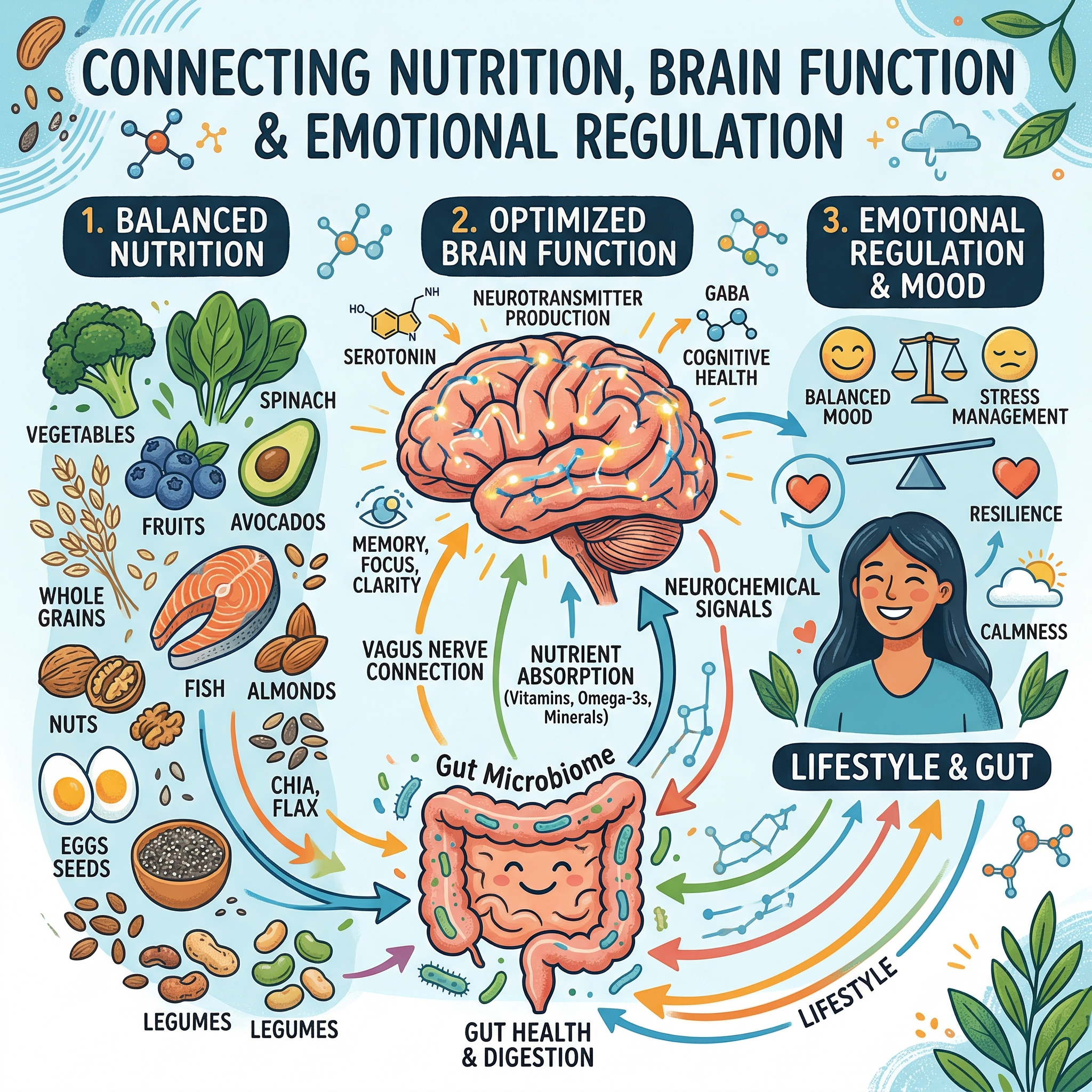
The Overlooked Truth: Mental Health Is Biological, Not Just Psychological
Mental health is often framed as mindset.
But your brain doesn’t run on motivation.
It runs on fuel, chemistry, and recovery.
To function optimally, your brain requires consistent nutrients to:
regulate mood and emotional responses
manage stress hormones
recover after cognitive overload
sustain attention and decision-making
When this support is inconsistent, the effects don’t always look dramatic.
They show up subtly:
shorter patience
mental fog
low-grade irritability
difficulty switching off
These aren’t personality flaws.
They’re physiological signals.
Why High Achievers Are More Vulnerable to Nutritional Imbalance
High performers don’t neglect nutrition because they don’t care.
They neglect it because:
time feels scarce
efficiency feels urgent
slowing down feels like falling behind
So nutrition becomes:
fuel for output — not support for regulation
Over time, this creates a mismatch:
high cognitive demand
low biological recovery
And that’s where resilience quietly breaks down.
The Brain–Food Connection Most Professionals Overlook
Your brain relies on nutrients to produce neurotransmitters like:
Serotonin → emotional stability, calm
Dopamine → motivation, focus
According to the National Institutes of Health, consistent access to key nutrients supports memory, learning, and emotional regulation throughout adulthood.
When nutrition is inconsistent — even mildly — the effects may show up as:
mental fog
emotional reactivity
low frustration tolerance
difficulty switching off after work
These are not character flaws.
They are signals of an under-supported system.
What “Eating Well Enough” Gets Wrong
Many professionals eat reasonably well.
But “reasonable” often means:
skipping meals during busy periods
relying on convenience foods
inconsistent nutrient intake
eating without recovery awareness
The result?
You’re not malnourished —
but you’re also not supported.
And that gap matters.
How Poor Nutrition Quietly Impacts Mental Health
Research consistently shows that diets high in ultra-processed foods and refined sugars are associated with:
mood instability
energy crashes
increased inflammation
reduced cognitive clarity
But here’s the deeper insight:
The issue isn’t just what you eat.
It’s how consistently your body feels supported.
When support is inconsistent, your nervous system stays slightly on edge.
Not overwhelmed — just never fully settled.
Key Nutritional Foundations for Emotional Resilience
Instead of chasing optimization, focus on steadiness.
1. Omega-3 Fatty Acids
Support brain structure and reduce inflammation linked to mood instability.
Sources: fatty fish, walnuts, flax-seeds
2. B Vitamins (B6, B12, Folate)
Essential for energy, focus, and neurotransmitter production.
Sources: eggs, leafy greens, legumes
3. Antioxidants
Protect brain cells from stress-related damage.
Sources: berries, vegetables, dark chocolate
You don’t need perfection.
You need consistency over time.
Nutrition, Performance, and Emotional Regulation
Balanced nutrition doesn’t just improve health.
It improves how you respond to pressure.
With steady nourishment, you’re more likely to:
think clearly under stress
recover faster after demanding work
respond instead of react
This is what real resilience looks like.
Not pushing harder —
but being better supported.
More importantly, steady nutrition reduces the load placed on your nervous system, allowing you to respond rather than react.
This is resilience, not optimization.
Practical Nutrition Habits for High-Achieving Professionals
Forget perfection. Focus on repeatable support.
Anchor one reliable meal daily → creates stability
Balance meals (protein + fats + complex carbs) → sustained energy
Eat regularly → reduces emotional volatility
Hydrate consistently → improves focus and mood
Reduce sugar spikes → avoid energy crashes
These aren’t rules.
They’re ways to lower the load on your nervous system.
Common Barriers (And Smarter Ways Through Them)
“I don’t have time.”
→ Build simple defaults, not complex plans
“Healthy food is expensive.”
→ Focus on basics: eggs, beans, seasonal produce
“I crave sugar under stress.”
→ Often a signal of depletion, not lack of discipline
“I eat socially a lot.”
→ Aim for balance, not restriction
Progress — not perfection — restores trust with your body.
Frequently Asked Questions
How does nutrition affect mental health?
Nutrition influences mood, focus, and emotional stability by supporting brain chemistry and stress regulation.
Can food replace therapy or medication?
No. Nutrition supports mental health but does not replace professional care.
Which nutrients matter most for emotional well-being?
Omega-3s, B vitamins, and antioxidants play key supportive roles.
Final Insight
This isn’t about food.
It’s about:
self-support
If your ambition is supported:
it feels sustainable
If it’s not:
it becomes exhausting
You don’t need:
perfect nutrition
more discipline
more control
You need:
Consistent support
Reduced pressure
A system that allows recovery
Some professionals eventually realize sustainable well-being also requires redesigning how they work, earn, and structure their energy. One approach I’ve personally explored is building more flexible, lower-pressure online income systems.
Disclaimer: This article is for educational purposes only and is not a substitute for medical or mental health care. Always consult a qualified healthcare professional for personalized advice.
Affiliate disclosure: I’m an active Wealthy Affiliate member and may earn a commission if you purchase through links on this page. I only recommend products I use and believe provide value. No extra cost to you.
Quick verdict: Wealthy Affiliate is a beginner-friendly, all-in-one platform that bundles hosting, training, and keyword tools — excellent value for new and scaling affiliate marketers.
Written by Nhlanhla Nene
Nhlanhla is a Wellbeing Coach, Mindvalley Certified Life Coach, and the founder of Mindedjoy. With advanced training in narrative, personal, and corporate coaching, and a rich career background as a Certified Global Management Accountant, (ACMA, CGMA) – he blends psychology-based coaching with real-world leadership insight. His mission is to help high-performing professionals bridge the achievement–fulfillment gap, strengthen resilience, and build lives filled with meaning, joy, and sustainable success.